LaTeX Cover Letter Templates: Job, Postdoc and Journal Letters
A cover letter in LaTeX is one page on the letter class, or a template whose header matches your CV. Which to use depends on who reads it: a hiring manager wants a plain page, a search committee wants to see the position and your enclosures, and a journal editor wants the manuscript details before the first sentence. Below are four templates that open and compile as they are, and the letter class itself to copy.
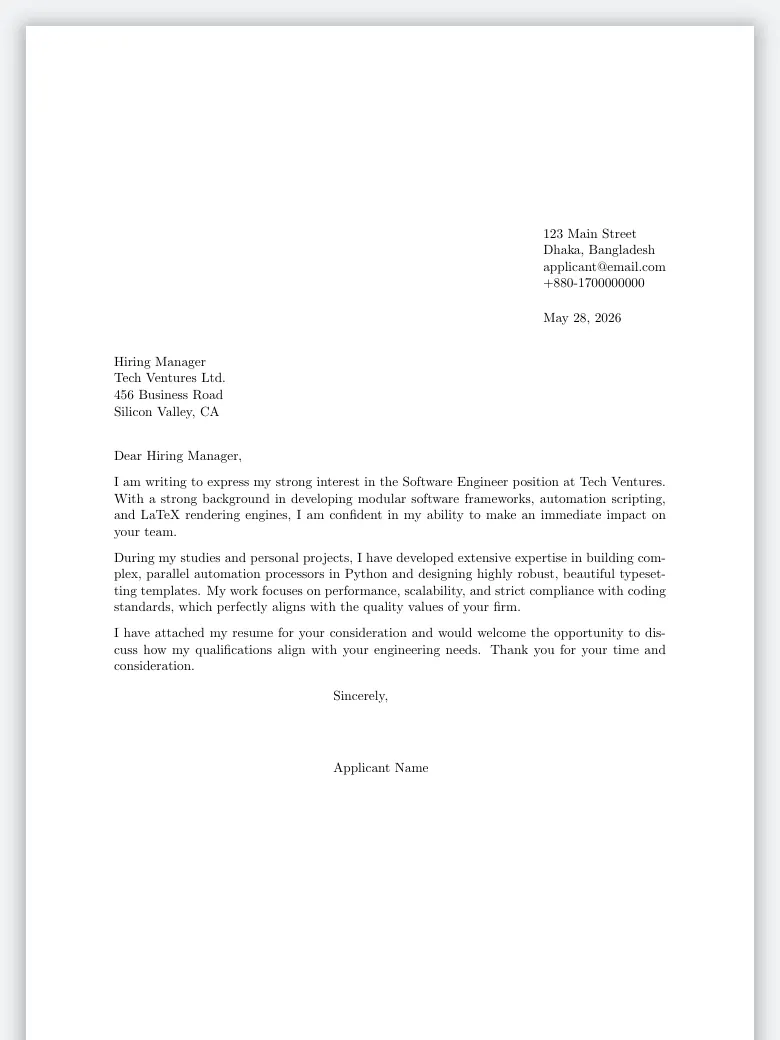
Cover Letter
Plain, one page
Your address and the date on the right, the recipient on the left, three paragraphs and a signature. Nothing to distract.
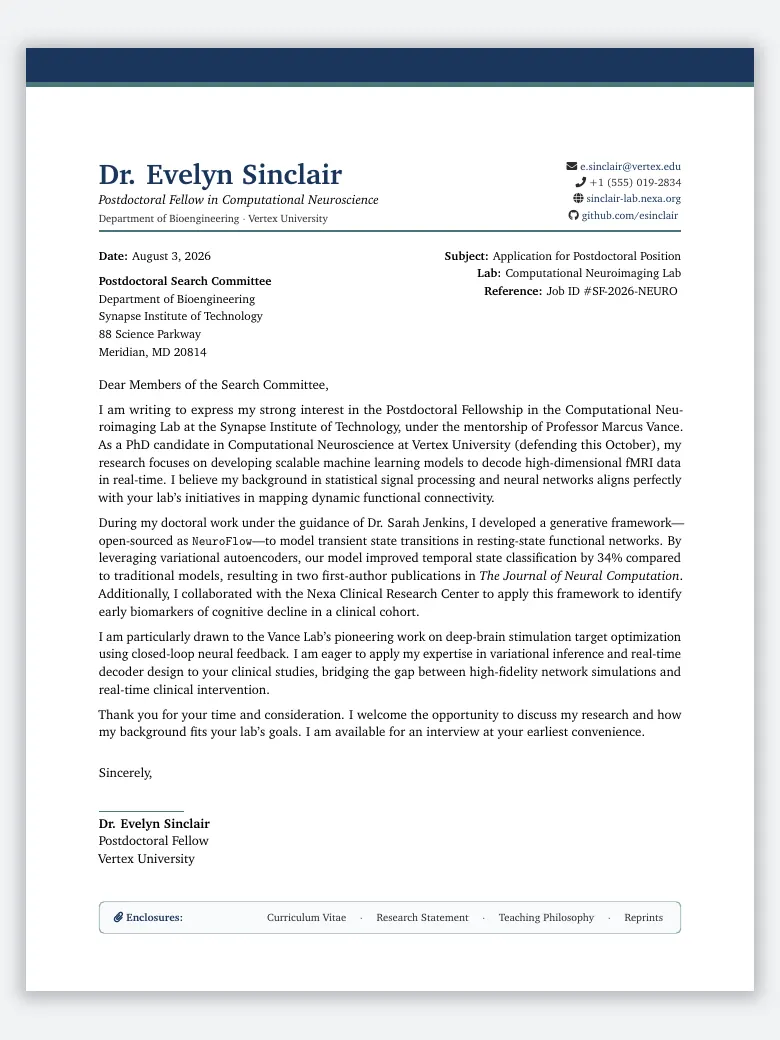
Postdoc Application Letter
Letterhead, subject block
A coloured band and your name as a letterhead, the position and reference set out beside the date, and a line of enclosures.
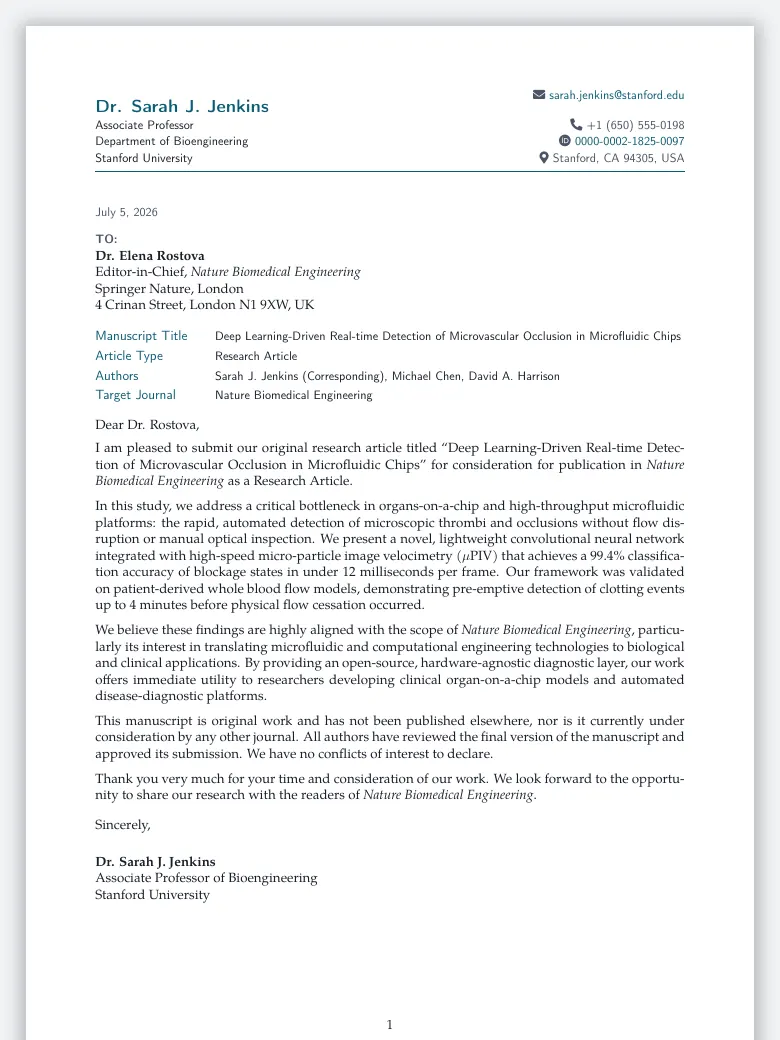
Journal Cover Letter
For a submission
Your letterhead with ORCID, the editor’s address, then the manuscript title, article type and authors set out before the letter.
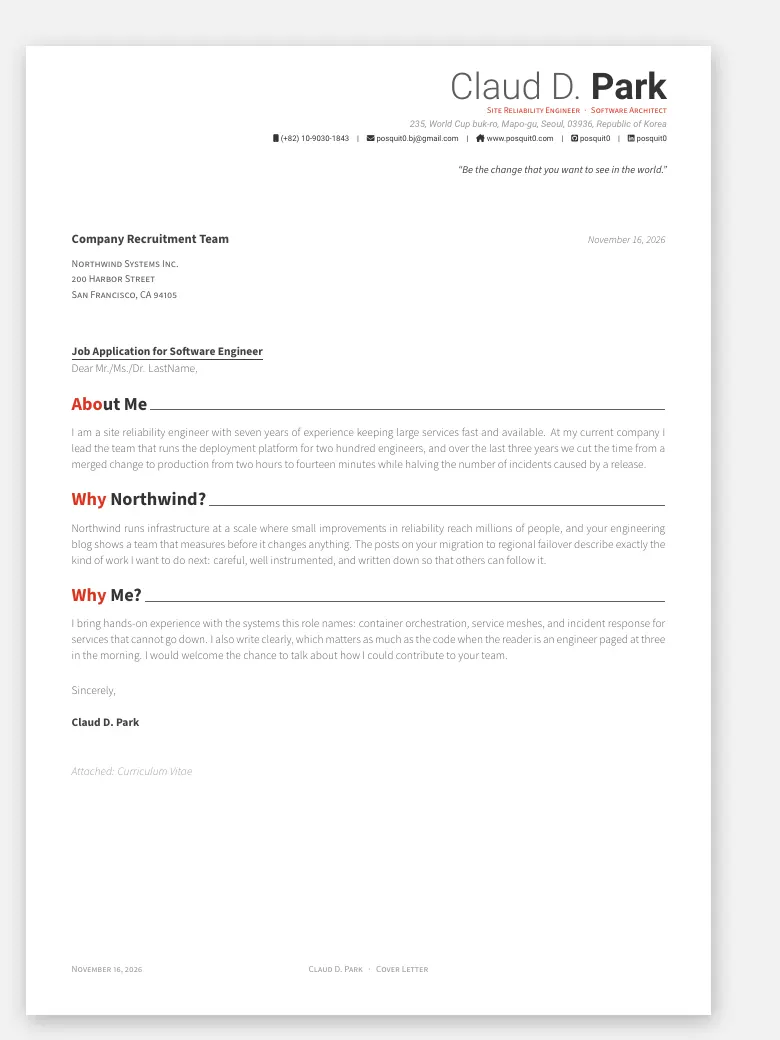
Awesome CV Cover Letter
Matches Awesome CV
The letter that goes with the Awesome CV résumé: the same header, coloured section headings and a footer. Builds with XeLaTeX.
The Awesome CV letter is for a CV built on Awesome CV: it carries the same header. For the CV itself, see the best LaTeX résumé templates; for a letter on headed paper, LaTeX letterhead templates.
A cover letter in LaTeX with no template
The standard letter class does the layout: your address and the date at the top right, the recipient at the left, the signature under the closing. This file compiles as it is.
\documentclass[11pt]{letter}
\usepackage[T1]{fontenc}
\usepackage[margin=1in]{geometry}

\signature{Your Name}
\address{12 Your Street \\ 12345 Your City \\ you@example.com}

\begin{document}

\begin{letter}{Hiring Manager \\ Company Name \\ 34 Their Street \\ 67890 Their City}

\opening{Dear Hiring Manager,}

I am writing to apply for the position of Research Engineer advertised on your
careers page. The role asks for experience with large simulations and with
writing them up clearly, which is the work I have done for the last three years.

At my current post I rebuilt the group's fluid solver so that a run which took
a night now takes an hour, and wrote the documentation that let two new
colleagues use it in their first week. I would bring the same care to your team.

I would welcome the chance to talk about the role. My CV is enclosed.

\closing{Yours sincerely,}

\encl{Curriculum vitae}

\end{letter}

\end{document}
\addressand\signatureare yours, set once before the letter.- The argument of the
letterenvironment is the recipient, one line per\\. \openingand\closingtake the greeting and the sign-off; the date is today’s unless you set\date.\encllists what is enclosed, and\ccwho else receives it.
What each kind of letter needs
- A job application. The role by its exact title, two pieces of evidence that match what the advert asks for, and how to reach you. One page.
- A postdoc or faculty application. The position and its reference, how your research fits the group, what you would do in the first year, and the documents enclosed: CV, research statement, names of referees.
- A journal submission. The title and article type, what is new, why this journal, and the statements its instructions ask for. Check them on the journal’s own page: they differ.
Matching the letter to your CV
A letter and a CV that share a font and a header read as one application. The simplest way is to use the letter that belongs to your CV’s class: Awesome CV has one, and moderncv has letter commands of its own (\recipient, \opening, \closing, then \makelettertitle and \makeletterclosing). With the plain letter class, load the same font package as your CV and leave the rest alone.
Frequently asked questions
How do I write a cover letter in LaTeX?
Use \documentclass{letter}. Set your name with \signature and your address with \address, then open a letter environment with the recipient's address, write \opening{Dear ...,}, the paragraphs, and \closing{Yours sincerely,}. The class places the addresses, the date and the signature for you.
Should my cover letter match my CV?
Yes, when they are read together: the same font, the same accent colour and the same header make the two pages one application. If your CV uses Awesome CV or moderncv, use the letter that comes with it instead of a separate template.
How long should a cover letter be?
One page. Three or four short paragraphs: why you are writing, the evidence that you fit, and how to reach you. A postdoc application letter may run to a page and a half where the advert asks for research plans in the letter.
What goes in a cover letter to a journal?
The manuscript title and article type, one paragraph on what is new and why it suits that journal, and the statements the journal asks for: that the work is original, is not under review elsewhere, and that the authors have approved it and declare any conflicts of interest.
Can I add my signature as an image?
Yes. Load graphicx and put \includegraphics[height=1.2cm]{signature.png} above your name in \signature, for example \signature{\includegraphics[height=1.2cm]{signature.png}\\ Your Name}. Scan the signature on white paper and crop it closely.
Keep reading
Ready to try LetX?
Join researchers and students focusing on their work, not the tools.
Get Started Free
Written by Shihab Shahriar Antor , AI Engineer & Founder of Shahriar Labs. Builder of LetX (collaborative LaTeX) and offSchool (SSC science and maths, learned through simulations).